Suku Masks: Royal Court Charms in the Southwestern Congo
New: the 2nd edition of Within Carved Lines: The Secret Meanings of African Masks is out now. Get the book →
Most masks are built to move an audience through performance, through dance, through song. The most feared Suku mask was built to do the opposite. Kakuungu was not supposed to dance at all. Its entire function was to appear, and to terrify simply by appearing.
That single fact tells you something important about Suku masking before we go any further: it is not one mask with one job. It is a small toolkit of different masks, each carved for a different moment in a person’s life or a community’s calendar, some to frighten, some to heal, some to mark a boy becoming a man, some to quietly hold a chief’s authority in place. Once you see it that way, a mask that terrifies and a mask that heals stop looking like a contradiction and start looking like two tools doing two different jobs for the same people.
Who Are the Suku?
Around 80,000 Suku people have lived in the southwestern Democratic Republic of the Congo since the sixteenth century, settled along the Kwango River in a landscape of forest broken by farmland, the kind of terrain that shapes an economy built on both cultivation and the hunt. Farming is their main livelihood, with women cultivating yams, manioc, and groundnuts in fields cleared from the surrounding bush. Men supplement this by hunting with dogs in the forest, by occasional fishing in the Kwango itself, and by tending palm tree plantations, which supply palm oil, an important commodity in both local and international trade. Hunting rarely puts much meat on the table by volume, but it carries weight far beyond its calories. Among Suku men, the ability to hunt well remains a defining marker of status and manhood, which matters, because it is precisely this same rite of passage into manhood that produces the masks discussed below.
Art as Royal Court Business
Suku wood sculpture functions as royal court art, directly linked to social hierarchy rather than existing independently of it. Statues containing magic ingredients, placed inside a figure’s abdomen and sealed with a resin stopper, or carried in small bags around the neck or waist, could be malevolent or beneficial depending on how they were used, and were kept in a hut standing within the enclosure of the chief’s own house, not in any household at random.
Suku sculptors in the north carve the mulomba, a figure with one hand outstretched to solicit a gift, dressed in the hairdo typical of local territorial and lineage chiefs. Other Suku figures serve fertility ceremonies, or take kneeling and crouching fetish forms understood either as ancestor figures or as the personification of an evil spirit. This is the world a Suku mask is born into: an art tradition already organized around a chief’s household and a chief’s authority, long before the mask itself ever appears in public.
One People, Several Masks: Why Suku Masking Isn’t a Single Thing
It helps to think of Suku masking less as a single object and more as a small set of specialized roles, each tied to a specific moment. There is a mask meant to be worn by boys coming of age, appearing only during the season when a new group of initiates completes n-khanda. There is a mask meant to be worn, or rather displayed, by a ritual specialist whose entire job is to frighten rather than perform. And there is a helmet mask meant to invoke the authority of dead chiefs, called on for practical needs like a successful hunt, a healing, or a punishment. None of these masks substitute for one another. Each belongs to its own occasion, and understanding that division is what makes the rest of this tradition make sense.
N-khanda: The Initiation Behind the Masks
Like their Yaka neighbors along the same river system, and in a system so closely related that the two peoples’ initiation practices are best read side by side, the Suku practice n-khanda, an initiation built around a secluded forest retreat that ends in circumcision and is marked by masked festivities, dance, and song. Suku masks made for this occasion were understood to serve several distinct functions at once: protection against evil forces, ensuring the fertility of the young initiate, frightening the watching public, healing the sick, and casting spells. A single mask season, in other words, could be asked to do all of that at once, which is part of why n-khanda masks tend to combine several visual registers, gentle and threatening, in the same carved face.
Kakuungu: The Mask That Must Not Dance
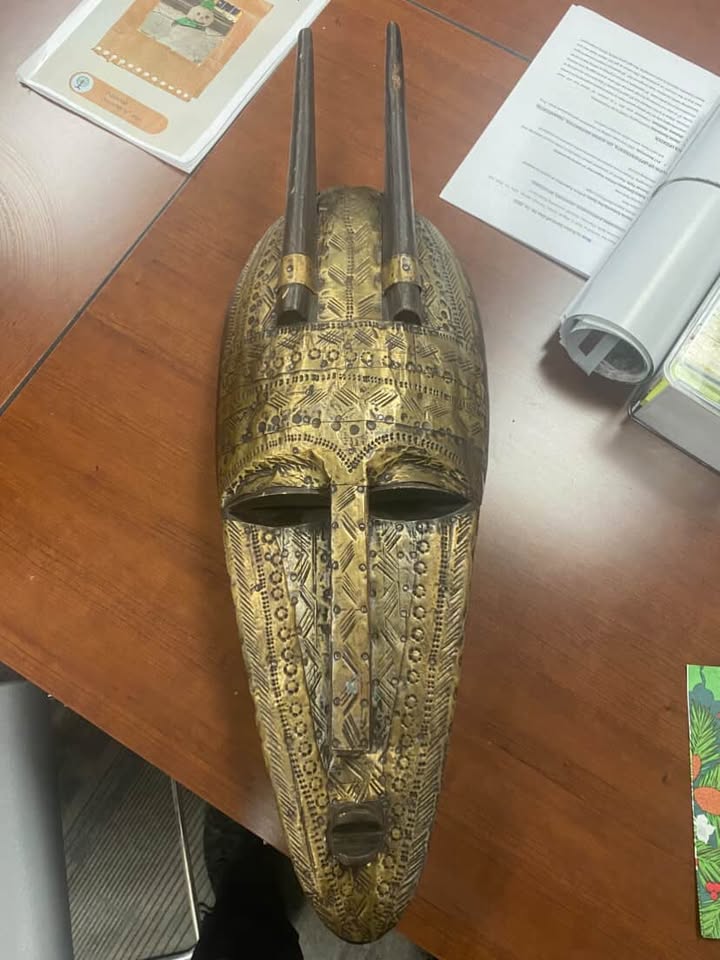
Not every mask in this tradition performs the same way. The charm masks belonging to the initiation specialist specifically do not dance. Their purpose is to appear and to provoke terror through appearance alone, and the most feared of these is kakuungu, recognized by swollen cheeks, massive exaggerated features, and a protruding chin. Where most masks discussed on this site work through movement, kakuungu works through stillness and presence, closer to a warning sign planted at the edge of the initiation camp than to a performer at a festival.
It is worth noting, because it is easy to confuse, that the Yaka, the Suku’s close neighbors along the Kwango, have their own senior initiation mask called kakuunga, “the chief.” The names are close enough to share an obvious root, and the two peoples share the n-khanda institution itself, but the masks are not identical and belong to two distinct, if closely related, traditions.
The Hemba Helmet Mask
The Suku also carve a helmet mask they call hemba, a name shared with, but unrelated to, the separate Hemba ethnic group of southeastern DRC, an unrelated people with their own distinct ancestor figure tradition. Cut from a single cylinder of wood, the Suku hemba mask is often surmounted by a carved figure of a person or animal, and is understood to represent the community of deceased elders, particularly chiefs from the maternal lineage, the line through which Suku authority and inheritance actually passes. The hemba helmet mask served practical, requested purposes: promoting success in the hunt, healing, and punishing wrongdoers, and it was also worn by dancers during specific initiation ceremonies, unlike the stationary kakuungu.
A Living Court Art
Put together, a Suku mask collection reads less like a museum wall of similar objects and more like a small government: a mask for the coming of age of the young, a mask for enforcing fear and order among the initiated, and a mask for calling on the authority of the dead on behalf of the living chief. Each was made for its own season and its own occasion, tied back to the same royal household that also held the carved figures discussed above. That is the throughline worth carrying into every other masking tradition on this site: a mask’s meaning rarely stands alone. It only makes full sense next to the other masks it was carved to work beside.
Frequently Asked Questions
What makes the kakuungu mask different from most African masks?
Kakuungu does not dance. Its function is to appear and to terrify through its appearance alone, recognized by swollen cheeks, exaggerated features, and a protruding chin.
Is the Suku “hemba” mask connected to the Hemba ethnic group?
No. The name is shared, but the Suku hemba helmet mask and the Hemba people of southeastern DRC are separate traditions with no direct connection beyond the coincidence of the name.
What is n-khanda among the Suku?
It is the Suku male initiation, centered on a secluded forest retreat and circumcision, closely paralleling the same institution, and sharing a similarly named senior mask, among their Yaka neighbors along the Kwango River.
Why is Suku sculpture described as royal court art?
Because its production and use are directly tied to the social hierarchy surrounding a chief, including figures kept within the enclosure of the chief’s own house rather than existing as independent religious objects.
See also: African Masks by Region and Tribe · Where African Masks Are Traditionally Kept and Why · How to Decode Your Traditional African Mask

Brooklyn Museum (gift of Dr. and Mrs. Abbott A. Lippman). Licensed CC BY 3.0.