Kifwebe Mask of the Songye and Luba: Striped Faces of Power and Judgment
New: the 2nd edition of Within Carved Lines: The Secret Meanings of African Masks is out now. Get the book →
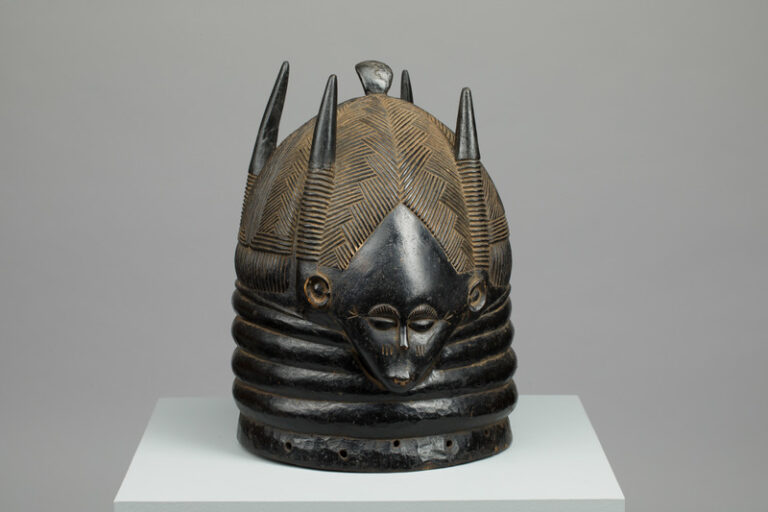
Few African masks are as immediately recognizable as Kifwebe. The carved concentric lines running across the face, the tall ridged crest rising from the forehead, and the stark geometric planes have made Kifwebe one of the most photographed, most collected, and most imitated mask forms to come out of Central Africa — a visibility that has made 20th-century European artists take note, while somewhat obscuring the mask’s actual role among the Songye and Luba peoples who made and used it.
Who Are the Songye and Luba?
The Songye and Luba peoples live across a broad stretch of the southeastern and central Democratic Republic of Congo, historically organized around powerful centralized kingdoms — the Luba Empire in particular was one of Central Africa’s most significant precolonial states, with a sophisticated system of sacred kingship and a body of court art, regalia, and memory devices that reflected its political complexity. The Songye, closely related and geographically adjacent, developed their own centralized chieftaincies alongside a distinct artistic tradition, of which Kifwebe is the most visible expression.
The Bwadi bwa Kifwebe Society
Kifwebe masks are made, owned, and controlled by the Bwadi bwa Kifwebe, a men’s association that operated across Songye and, in a related form, Luba communities. The society functioned as far more than a masking guild: it held real judicial and political authority, appearing at the installation and death of chiefs, presiding over initiations, and — in some documented cases — acting as a kind of moral and legal enforcement body, appearing to identify wrongdoing, resolve disputes, and discipline behavior that threatened community order.
This civic function is part of what makes Kifwebe distinct from masks whose role is primarily spiritual or ancestral. A Kifwebe mask appearing in a village was, in a very real sense, an exercise of institutional power — closer to the arrival of a magistrate than a purely ceremonial visitor.
Reading the Mask: Color, Crest, and Striation
Kifwebe’s most distinctive feature is the pattern of raised, carved lines radiating across the face, often compared by art historians to the visual language later explored by early twentieth-century European Cubist painters, several of whom encountered Central African masks through colonial-era collections. But the striations are not simply decorative: their density, direction, and combination with color carry specific meaning within Songye and Luba visual language, communicating the mask’s role and temperament before it even moves.
Color follows a consistent symbolic logic. White-dominant Kifwebe masks are generally associated with calm, daylight, moral rectitude, and the resolution of disputes — a visual register of restraint and legitimate authority. Masks combining red and black, particularly those built with taller, more exaggerated crests, are associated with danger, aggression, and destabilizing power, appearing in more volatile or threatening contexts. A viewer familiar with the tradition could read a Kifwebe mask’s likely role in a given performance simply from its palette, well before understanding the specifics of the occasion.
Male and Female Kifwebe
Kifwebe masks are typically produced and danced in gendered pairs, with the male and female versions distinguished by scale and crest height rather than a difference in basic form. Male Kifwebe masks generally carry taller, more pronounced sagittal crests and are associated with more forceful, energetic dancing and a more volatile social role. Female Kifwebe masks are usually smaller, with a lower or absent crest, and are associated with calmer movement and a more measured social presence, often linked to the mask’s role in maintaining rather than disrupting order.
This pairing echoes a pattern that shows up elsewhere in African masking — Sowei and the Sande society, and the Deangle and Tankagle masks of the Dan, are both discussed elsewhere on this site — in which gendered mask pairs are used to represent a fuller, balanced picture of social and spiritual authority than either could alone.
Kifwebe Masks in the World
Kifwebe masks are extensively held in major collections, including the Metropolitan Museum of Art and the Brooklyn Museum, and their striking, graphic visual style has made them one of the most consistently reproduced African mask forms in the commercial art and tourist market. That popularity cuts both ways: it means Kifwebe is relatively easy to find, but it also means the mask form has been more heavily targeted by workshop reproductions and deliberately aged fakes than most other traditions discussed on this site. Anyone buying rather than simply studying a Kifwebe mask should treat the striation quality, wood, and wear patterns with real scrutiny — a topic covered in more depth in our buying guide.
Frequently Asked Questions
What does the word Kifwebe mean?
Kifwebe (plural bifwebe) means “mask” in the Songye language, and the term has come to refer specifically to this striated masking tradition associated with the Bwadi bwa Kifwebe society.
Why do Kifwebe masks have raised lines across the face?
The carved striations are a deliberate visual language, not pure decoration — their pattern and combination with color communicate the mask’s role, temperament, and the kind of authority it represents.
What is the difference between male and female Kifwebe masks?
Male masks typically have taller crests and a more forceful presence, associated with volatile or disruptive power. Female masks are smaller, with a lower crest, associated with calm and the restoration of order.
Are Kifwebe masks still made today?
Reproductions are made in significant numbers for the international art and tourist market. Masks made and used within an active Bwadi bwa Kifwebe context are far less common, and provenance matters a great deal in distinguishing the two.
See also: Every Traditional African Mask You Should Know · Pende Mask of the Congo: Types, Meanings, and Ceremonial Use · I Decoded African Masks and Their Color Symbolism · African Masks for Sale: A Buying Guide