Congo Masks: The Mask Traditions of the Congo Basin, People by People
There is no such thing as a Congo mask. There are perhaps two hundred distinct mask traditions inside the Congo Basin, belonging to peoples who did not think of themselves as one thing and still do not, and lumping them together is how the confusion started.
But the phrase is useful for one reason. Congo masks, taken together, represent the densest concentration of sculptural invention anywhere on the continent, and if you learn the major families you can place most of what you will ever encounter. So let us do that properly, people by people.
Why Congo masks dominate the collections
Two reasons, one good and one appalling.
The good reason is that the Congo Basin genuinely produced an extraordinary volume and variety of sculpture. Forest, river and savanna supported dozens of distinct polities, from centralised kingdoms with courts and guilds to small acephalous societies governed by initiation associations. Each developed its own visual language, and many developed several.
The appalling reason is that the Congo Free State and the Belgian Congo that followed it operated one of the most extractive colonial regimes in recorded history, and objects left in enormous quantities alongside the rubber and the ivory. The Royal Museum for Central Africa at Tervuren holds an African collection numbering in the tens of thousands. That is not a neutral fact about collecting. It is a consequence of a specific administration.
So when you look at Congo masks in a European case, you are looking at artistic achievement and at the machinery of extraction at the same time. Both are true.
The Kuba, where the mask is a constitution
The Kuba kingdom sits between the Kasai and Sankuru rivers and built a court art tradition with few rivals. Three royal masks perform together and the relationship between them is the entire point.
Mwaash aMbooy represents Woot, the founding ancestor and first king. Ngaady aMwaash is his sister and wife, her face marked with painted lines representing tears. Bwoom is the challenger, a broad forehead, a swollen brow, sometimes cast as a commoner, sometimes as a rival prince. When the three dance, the kingdom is replaying its own origin story, including the parts about incest and usurpation. A monarchy that publicly dramatises its own founding scandal every generation is doing something more sophisticated than propaganda.
Materially these are assemblages rather than carvings. Raffia cloth, cowrie shells, glass beads, leather, over a wood or basketry armature. The cowries were currency. The beads were imported and expensive. The mask is a balance sheet as well as a character.
The Songye and the Luba, power and restraint
Songye kifwebe masks are the ones everyone recognises without knowing the name. Deeply grooved striations running across the whole surface, a projecting mouth like a box, a central crest along the skull. The male form, with the high crest, belongs to the bwadi bwa kifwebe society and is associated with aggression and social control. The female form is flatter, whiter, quieter, associated with fertility and lunar power.
Next door, the Luba worked in almost the opposite register. Rounded, calm, polished surfaces. The Luba influence spread widely, which is why the Hemba to their east produced ancestor figures of such serenity, and why a great deal of material sat mislabelled as Luba in European museums until the nineteen seventies sorted it out.
The Kongo coast and the lower river
Among the Woyo and the Vili near the Atlantic coast, masks lean toward the judicial. Vili masks in bright pigment functioned as a kind of police presence. Woyo carving is best known for the proverb lids, carved pot covers whose motifs delivered a message a wife could place in front of her husband without saying a word.
The Yombe, an offshoot of the Kongo kingdom, became its finest sculptors, producing maternity figures and power objects of extraordinary finish. This region is also the home of the nkisi nkondi, the nail figures, which are not masks but are the objects most often misread as evidence of something sinister. They were legal instruments. Each nail or blade driven in records an oath sworn or a case activated.
The forest peoples and the eastern edge
Among the Lega, in the eastern forest, the bwami association governs everything, and its objects are not public spectacle but graded possessions. You do not buy a Lega mask. You earn the right to hold one by progressing through the ranks, and small ivory and wood masks may be held in the hand, hung on a fence, or worn on the temple rather than the face.
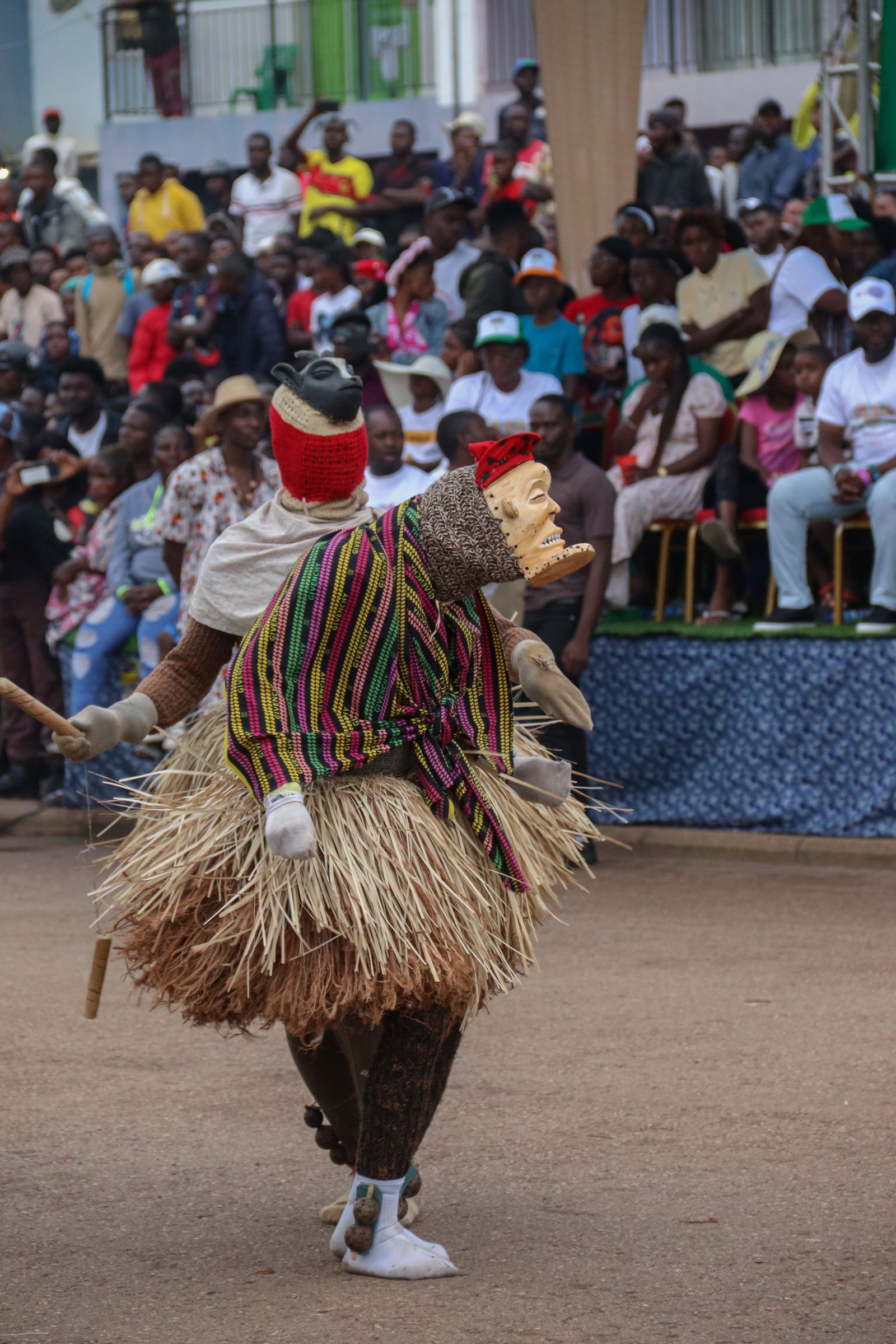
The Hemba So o mask, a chimpanzee face with a distorted mouth, stages the collapse of the boundary between village and bush at funerals. The Mbole hanged figures, the ofika, are carved warnings from a society that executed its own. The Suku, the Yaka, the Pende and the Chokwe each carry distinct initiation mask traditions, and the Chokwe Mwana Pwo, the idealised young woman, is among the most widely copied faces in African art.
How to read a Congo mask you are looking at
Start with surface treatment, because the Congo Basin is where surface carries the most information. Deep parallel striations point toward Songye and their neighbours. Heavy applied encrustation of resin, clay and sacrificial material points toward a power object rather than a dance mask. Raffia and cowrie assemblage points to Kuba. Smooth polished wood with a serene closed mouth points toward the Luba and Hemba orbit.
Then check the interior for genuine wear, as set out in our guide to identifying African masks. And for the continental context, our guide to African masks by region and tribe places these families against West and East African traditions.
The record that still needs writing
Most of what is confidently stated about Congo masks in the trade comes from a small number of mid twentieth century European field studies, some excellent and some very thin, and it has been recycled ever since. Whole traditions are described in a paragraph because one administrator wrote one paragraph.
That is fixable, and it is what this site exists to do. We work through Central African traditions one people at a time on the SEVICS Africa channel on YouTube.
If your institution or company wants to fund the documentation of Congolese mask traditions specifically, our corporate support page sets out how that partnership works. The objects are already catalogued. It is the knowledge that is missing.