What Are African Masks Made Of? The Materials Behind the Meaning
The first thing a carver does is not carve. He chooses a tree. And in most of the traditions we document, he does not choose it alone, and he does not choose it quietly.
So when people ask what are African masks made of, the honest answer starts earlier than they expect. It starts in a forest, with a man asking permission.
Let us go through the materials properly, because the material is never neutral. What a mask is made of tells you where it came from, who could afford it, what it was for, and often how old it is.
What are African masks made of? Start with wood
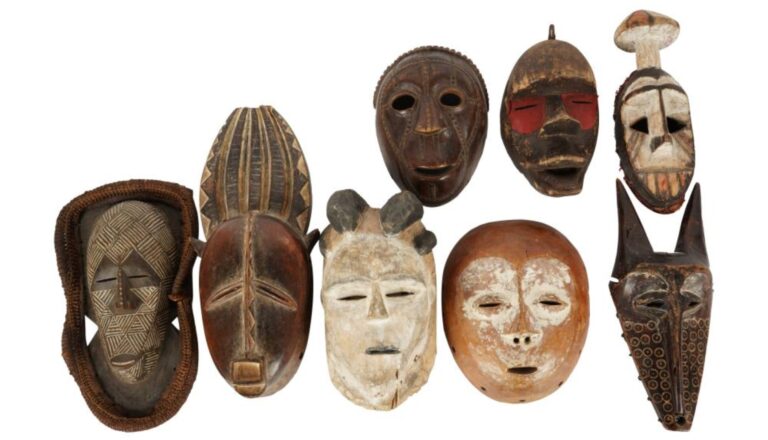
The overwhelming majority of African masks are wood. But wood is not one thing.
Carvers across West and Central Africa favoured light, soft, fast working timbers for masks that had to be worn and danced. Ceiba pentandra, the silk cotton tree, shows up constantly. So does obeche, and various species of Alstonia. These are chosen for a practical reason. A dancer has to carry the thing on his head or his face for hours in heat, sometimes while running. A mask carved from dense ironwood would break a neck.
Heavier woods appear where the object is not worn. Iroko, ebony, and African blackwood turn up in figures, stools, staffs, and doors. When you see a very dense, very heavy face mask with no wear inside, that is often your first signal that it was made for a market rather than a masquerade.
The tree itself frequently carries meaning. The silk cotton tree is regarded across much of West Africa as a dwelling place for spirits. Cutting one is not a casual act. In several traditions the carver offers something first, works at a particular time, and stays outside the village while the piece is in progress. The mask is understood to begin its life before the first cut.
Metal, and what it signals
Copper alloy is the aristocratic material. The Benin court in what is now Edo State in Nigeria produced brass and bronze heads, plaques, and pendant masks by lost wax casting, a technique that requires a guild, a furnace, patronage, and a supply of metal. That is why cast brass in West Africa almost always means a state, a court, or a wealthy association behind it. The Ife heads in terracotta and copper alloy, made several centuries before Benin’s peak, work the same way.
Metal also shows up as surface. Grebo and Dan area masks from Liberia and Cote d’Ivoire carry hammered sheet copper or aluminium tacked over the wood. Kota reliquary figures from Gabon are almost entirely defined by their sheet brass and copper facing. In the twentieth century, mirrors, nails, cartridge casings, and tin appear as carvers used what came through the trade.
Skin, fibre, cloth, and shell
In the Cross River region straddling Nigeria and Cameroon, the Ejagham and their neighbours did something almost nobody else did. They carved the wooden form, then stretched fresh antelope hide over it and let it dry tight. The result has a disconcerting realism, and it is why those headdresses look like they are about to speak.
Raffia is everywhere and almost always underestimated. It becomes the beard, the collar, the full body costume that hides the dancer, and in Kuba country in the Congo it becomes the mask itself. Bwoom and Mwaash aMbooy are built from raffia cloth, cowrie shells, beads, and leather over a wood or basketry core. The cowries are not decoration. Cowrie was currency. A mask covered in cowries is a mask covered in money, and the audience could count it.
In the Cameroon Grassfields, beadwork over cloth over wood is the royal register. A beaded elephant mask from the Bamileke Kuosi society announces that its wearer belongs to a society the king permits. Again, the material is the message.
Ivory, terracotta, and the exceptions
Ivory is rare and it is almost always royal, because in most kingdoms the elephant belonged to the ruler. The Benin ivory pendant masks representing the Queen Mother Idia are the famous case. They are hip ornaments worn at the waist, not face masks, which is a detail that gets lost every time the image is reproduced.
Terracotta belongs to the older layers. The Nok culture of central Nigeria was producing fired clay heads more than two thousand years ago. Ife produced naturalistic terracotta portraits. Clay does not get danced, but it tells us that the sculptural tradition in this part of the world is very old and very confident.
The surface, which is where the evidence lives
Colour on African masks is mineral and vegetable, not commercial, at least on older pieces. Three pigments do most of the work.
Kaolin, white clay, called nzu in Igbo. White marks the spirit world, the newly initiated, the dead, purity, and separation from ordinary life. A whitened mask is usually making a statement about which side of the boundary it stands on.
Camwood, ground to a red powder and mixed with oil, gives the deep reds. Red means heat, blood, danger, vitality, and royalty depending on where you are standing. Charcoal and soot give black. Indigo, and later imported laundry blue, give the blues on Cameroon and Kuba work. Yellow comes from ochres and from certain barks.
Then there is patina, and patina is the part collectors get wrong. A genuine danced mask accumulates its surface from use. Smoke from the storage hut. Palm oil rubbed in. Libations poured. Sweat on the interior. Teeth on the bite bar. Handling by the same six pairs of hands for forty years. That surface cannot be faked convincingly, and it is the single most useful thing to examine. Our guide to identifying African masks goes through it in detail, and the practical decoding guide for owners and collectors covers what to look for on a piece you already have.
The tools, briefly
Adze first, for the rough form. Then knives and small gouges for the detail. Then smoothing, often with the rough leaves of certain ficus species, which work like fine sandpaper. A carver working with an adze leaves a faceted surface under the finish, and those facets survive. Machine sanded surfaces do not have them. That is another line of evidence.
Why this matters beyond the object
Knowing what African masks are made of is not trivia. It is how you tell a court commission from a village commission, a danced object from a decorative one, a nineteenth century piece from a nineteen seventies airport carving. Material is the first layer of reading, and most people never get taught it.
We are building that teaching out in public, article by article and film by film, on the SEVICS Africa channel on YouTube. If you teach, or you are putting together a heritage programme, our corporate support page explains how institutions and companies can fund and use this work.
The tree was asked first. That is the part to remember.