Lumbo Masks: One Color Dances at Festivals, the Other Hunts Sorcerers
New: the 2nd edition of Within Carved Lines: The Secret Meanings of African Masks is out now. Get the book →
A number of masking traditions documented in this book use color to mark rank, age, or spiritual category. The Lumbo of southern and southwestern Gabon went further, building an entire moral division into a single shared mask style: carved the same way, danced the same way, but painted in one of two colors that decided what kind of work the mask was allowed to do. White masks turned up at celebrations. Black masks turned up to judge people and name sorcerers. That split, one style doing two opposed jobs depending only on its paint, is the throughline worth carrying through this piece. It says something particular about how the Lumbo organized moral authority: not through a separate object for punishment and a separate object for joy, but through the same face, recolored.

Who Are the Lumbo?
The Lumbo are an equatorial forest people settled in the south and southwest of Gabon, part of the intricate network of roughly forty ethnicities that make up the country, all sharing broadly similar institutions and a daily life shaped by a physically demanding environment. Lacking centralized political organization, Lumbo social life is concentrated in the village and the clan. Ancestors and tutelary spirits are worshipped, and it is the initiation brotherhoods, chief among them the mukudji society, that carry out the therapeutic and judiciary functions that elsewhere in this book are handled by chiefs or courts.
Mukudji: A Brotherhood That Heals and Judges
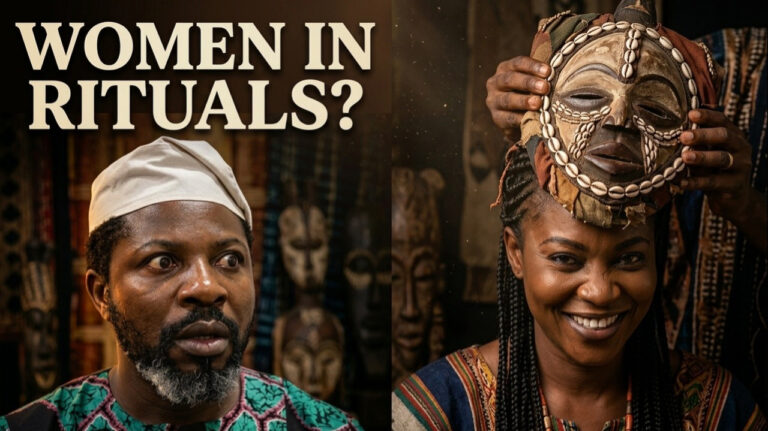
Lumbo artists carved figures influenced by both Punu and Kongo styles, and among the Lumbo, figurative sculpture serves two overlapping purposes: protection from malevolent forces and the promotion of fecundity. Their masks, called variously okuyi, mukuyi, or mukudji depending on the district, appear in funerary rituals, initiation ceremonies, and magical rites specifically aimed at unmasking sorcerers. They function as commemorative portraits of male and female ancestors, and the dancers who wear them often perform impressive acrobatics on stilts as they move through the village. Women and children generally keep their distance, though there is apparently no formal prohibition against the masks being seen by them.
White for Celebration, Black for Judgment
The white masks are famous throughout Gabon, realistic in style, with oval or triangular faces, hairdos composed of one or several loops, a dominant forehead, large coffee-bean-shaped eyes with slightly hollowed sockets, and a realistic nose with pronounced nostrils. The lips are outlined, the cheekbones protrude, the chin comes to a point. These white masks take part in celebrations, their appearance tied to festivity rather than to any accusation or verdict. The black masks, carved to the same basic template, carry the opposite job entirely: they operate as judges and help identify sorcerers, turning the same visual language that produces a festival face into an instrument of communal justice.
Statuettes with Braided, Horn-Shaped Hair
Beyond the masks, Lumbo statuettes are recognizable by their braided hair, which terminates in a distinctive horn shape. Their original function is no longer known, though their small size suggests they served as protective charms carried on the person rather than displayed in a shrine. The same facial features found on the white masks reappear here, and a slight bulging visible around the face on some statuettes suggests that certain figures may represent a person wearing a mask rather than a bare face, blurring the line between the sculpture and the masking tradition it echoes.
Frequently Asked Questions
What is the difference between Lumbo white masks and black masks?
Both are carved in the same basic style, but white masks take part in celebrations while black masks operate as judges and help identify sorcerers, with color rather than form determining the mask’s role.
What is the mukudji society?
Mukudji is a Lumbo initiation brotherhood that carries out therapeutic and judiciary functions, roughly the equivalent of a chief or court in the many decentralized Gabonese communities that lack a central political authority.
What are Lumbo masks called?
Depending on the district, they are called okuyi, mukuyi, or mukudji, and they serve as commemorative portraits of male and female ancestors, danced by performers who often use stilts.
What do Lumbo statuettes look like?
Small figures with braided hair ending in a horn shape, likely used as protective charms, sharing the same facial features as the white masks and sometimes appearing to depict a masked person rather than a bare face.
See also: African Masks by Region and Tribe · Punu Masks: The White Face of the Dead, Dancing on Six-Foot Stilts · Vili Masks: A Police Force in Paint, on the Atlantic Coast · Every Traditional African Mask You Should Know