Grebo Masks: The War Face Built to Terrify, and the Chief Who Ruled Alone
New: the 2nd edition of Within Carved Lines: The Secret Meanings of African Masks is out now. Get the book →
Nearly every people documented in this book’s Liberian section organizes at least part of village authority through the Poro society, the region’s dominant men’s institution. The Grebo, a little-known ethnic group of eastern Liberia’s coastal region and bordering forestlands, are the exception: unlike their neighbors, they are not structured by Poro at all, ruled instead by a single chief called the bodio, who lived in near total isolation and doubled as the community’s grand priest. That refusal of the region’s dominant institutional model, replaced by one man living apart from everyone else, is the throughline worth carrying through this piece. It sits alongside a masking tradition split just as sharply: one type of Grebo mask built purely to terrify in war, another built to embody a gentle female ideal.

Who Are the Grebo?
“Grebo” means “leaping monkey people,” a name the group traces to their flight from a former homeland near the Sahara. Their major economic activity today is producing palm oil and palm kernels for export. The Grebo inhabit the coastal region of eastern Liberia and the bordering forestlands, and their culture was shaped to a considerable degree by their neighbors to the north, the Kran and the Dan, even as their political structure marks a clear departure from the regional norm.
Bodio: A Chief Who Lived in Isolation
Where most neighboring Liberian peoples organize authority through the Poro society, the Grebo do not. Instead, they are ruled by a chief known as the bodio, who lives in near total isolation and also assumes the function of grand priest. That combination of political and religious authority concentrated in one isolated figure, rather than distributed across an initiation society’s membership, is an unusual structural choice among the peoples documented in this section of the book, and it shapes how Grebo masking authority is understood: less a society’s collective claim, more a solitary chief’s domain.
Three Masks: Massive, Female, and Built for War
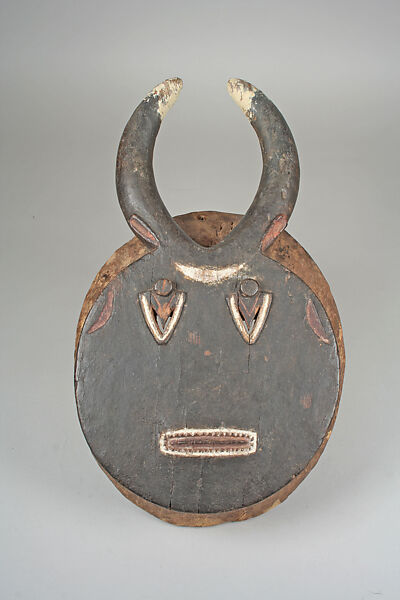
The Grebo sculpt several distinct types of masks. One type is characterized by a massive face surmounted by two buffalo horns. A second type represents the female ideal, with slit eyes and a deliberate sweetness of expression. A third type, the male war masks, are more abstract and flat, formed as a board with an elongated nose and one or more pairs of tubular eyes. These masks appeared during rituals reserved for initiates and at festive occasions, when the whole population was able to see them. The war masks, designed primarily to terrify, appeared specifically during battles, in the dances that preceded them, and at the funerals of warriors, giving Grebo masking a martial edge sharper than the gentler female-ideal type carved by the same tradition. Figures are comparatively rare among the Grebo, and their sculptural style is closely related to that of the Dan, the We, and other neighboring tribes.
Frequently Asked Questions
What does “Grebo” mean?
It means “leaping monkey people,” a name tied to the group’s traditional account of their flight from a former homeland near the Sahara.
Who is the bodio?
The bodio is the Grebo chief who rules in near total isolation and also serves as grand priest, a structure that replaces the Poro society used by most neighboring Liberian peoples.
What are the three types of Grebo masks?
A massive-faced mask topped with two buffalo horns, a female-ideal mask with slit eyes and a sweet expression, and a flat, abstract war mask with an elongated nose and tubular eyes.
What was the Grebo war mask used for?
It was designed primarily to terrify, appearing during battles, in the dances that preceded them, and at the funerals of warriors.
See also: African Masks by Region and Tribe · Bassa Masks: The Gela Dancer Who Performs Feminine Grace for an All-Male Society · Every Traditional African Mask You Should Know · African Coming-of-Age Ceremonies: How Different Cultures Mark the Transition to Adulthood